NIGERIAN VS BRIT: VIRAL TWITTER BATTLE OVER ENGLISH PROFICIENCY SPARKS BIGGER DEBATE
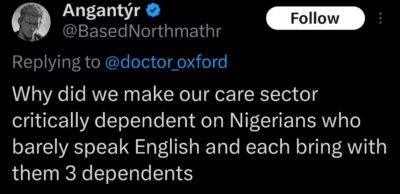
A spirited exchange on Twitter has captured global attention, pitting a Nigerian user against a British one in a challenge that’s gone beyond banter — straight into the heart of immigration, language, and respect.
It all began when a British user, @BasedNorthmathr, tweeted a controversial opinion questioning why the UK care sector had become “critically dependent on Nigerians who barely speak English.” The post immediately sparked outrage and debate, but one Nigerian user, @ifedayo_johnson, decided to respond in a way no one saw coming.
“Let’s settle this with an IELTS test — reading, writing, speaking, listening,” Ifedayo tweeted.
“If your overall score is higher than mine, I’ll leave the UK in 24 hours. But if I win, you must never again question or disrespect the English skills of Nigerians.”
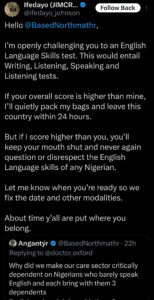
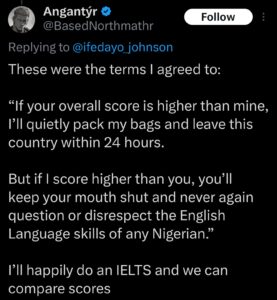

Surprisingly, the British user accepted the challenge, stating, “I’ll get back to you,” leaving followers eagerly waiting for what may become a viral online duel in linguistic skills.
More Than Just Twitter Drama
While this may seem like a Twitter skirmish, it taps into a growing controversy. The UK government is proposing mandatory annual English language tests for migrant graduates who remain in the country through the Graduate Route. The policy, aimed at retaining only the so-called “best and brightest,” has stirred concern, especially among migrants from English-speaking countries like Nigeria.
For many Nigerians, English is not just a second language — it’s the language of instruction in schools, universities, and formal settings. Yet they are often scrutinized based on accents, not fluency, in Western societies.
A Test of More Than Grammar
If the online IELTS-style challenge goes ahead, many Nigerians see it as more than a test — it’s a stand for recognition, equality, and respect.
As one Twitter user put it:
“It’s about time people understood that speaking English with an accent doesn’t mean you don’t speak it well. Fluency is not Britishness.”
Ifedayo has since gained praise across social platforms for confidently standing up to a stereotype. And now, all eyes are on the outcome of what could be the most talked-about online test of 2025.
What do you think? Should fluency be measured by accent or actual command of the language? Share your thoughts below.